
Centrifugal pumps employ various types of impellers, each suited to specific scenarios based on their performance characteristics.
1. Impeller Classification
- Open Impeller: With exposed blades, it is suitable for transporting fluids containing high solid particles (such as slurry or sewage) and can effectively handle particulate matter.
- Closed Impeller: Equipped with cover plates on both sides of the blades, it offers higher efficiency and is ideal for clean, low-viscosity fluids. It is commonly used in water supply and chemical processing applications.
- Semi-open Impeller: Combining the designs of open and closed impellers, its blades are partially enclosed, providing broad applicability. It is often used in working conditions with medium solid content.
- Vortex Impeller: Separates fluids from solid impurities by forming a vortex, making it particularly suitable for handling high-viscosity or fiber-containing fluids.
- Axial Flow Impeller: Directs fluid to flow parallel to the impeller's axis, primarily used in scenarios requiring high capacity and low pressure.
- Radial Flow Impeller: Pushes fluid outward radially, typically applied in situations needing higher pressure (e.g., fire protection systems, boiler feed water systems).
Selecting the appropriate impeller type requires comprehensive consideration of multiple factors, including the performance requirements of the application, the characteristics of the fluid being transported, and the desired operating efficiency. For fluids with different solid particle contents, open impellers or vortex impellers are more suitable due to their resistance to clogging and effective handling of particulates. Conversely, closed impellers are a better choice for processing clean fluids while pursuing higher efficiency.
2. Impeller Structure
| Impeller Type | Core Structure | Key Characteristics |
|---|---|---|
| Open Impeller | Cylindrical hub + 3-6 curved blades | No front or rear cover plates; blade roots fixed to the hub, tops fully exposed; blades evenly distributed around the hub circumference. |
| Closed Impeller | Hub + blades + circular front cover plate + circular rear cover plate | Front and rear cover plates fully connected to blade edges, forming a closed annular flow channel; hub located at the center of the rear cover plate. |
| Semi-open Impeller | Hub + blades + circular rear cover plate | Only the rear cover plate is retained; blade tops are unobstructed; blade roots fixed to the hub and rear cover plate. |
| Vortex Impeller | Disc-shaped hub + annular vortex chamber + short blades | Blades are short and thick, located in the annular area at the edge of the hub; an annular vortex space is reserved around the impeller. |
| Axial Flow Impeller | Cylindrical hub + propeller-like blades | Blades are spirally inclined at an angle of 15-45° to the hub axis; fluid enters and exits along the axial direction. |
| Radial Flow Impeller | Conical hub + radially curved blades + rear cover plate | Blades distributed along the radial direction of the hub, with a curvature matching the rotation direction; fluid is sucked from the center and discharged radially. |
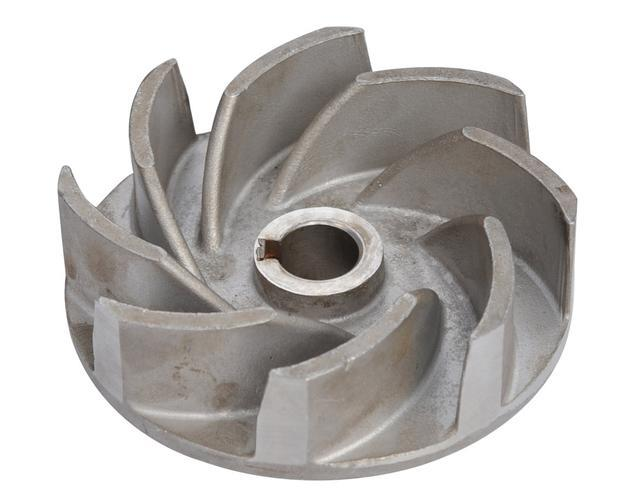
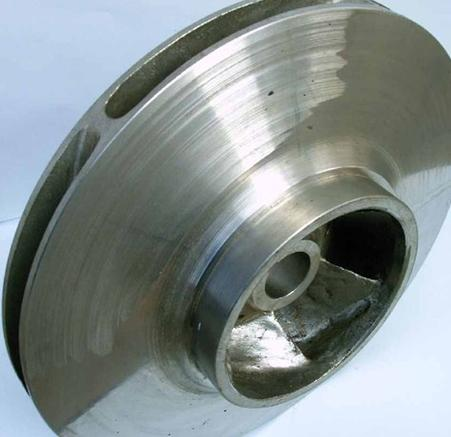
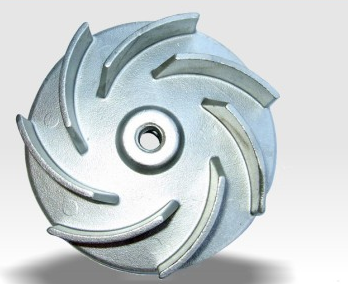
(Open Impeller) (Closed Impeller) (Semi-open Impeller)
3. Working Principles of Different Impeller Designs
The design of the impeller affects pump performance and determines how fluid is transported in the system.
- Open Impeller: Its uncovered blades allow a large amount of solid and particle-containing fluid to pass through. The working principle is to form a low-pressure zone at the center of the impeller; as the blades rotate, fluid is sucked in and pushed outward. It can efficiently handle large solid particles and reduce the risk of clogging, making it highly suitable for transporting media such as slurry.
- Closed Impeller: Equipped with front and rear cover plates, it generates a higher pressure difference, which can enhance fluid velocity and overall efficiency. When the impeller rotates, fluid is discharged at high speed radially under the action of centrifugal force. This characteristic makes closed impellers particularly suitable for systems requiring stable and high-flow transportation of clean fluids.
- Semi-open Impeller: Combines the characteristics of open and closed impellers. Its partially enclosed blades provide a certain degree of protection while effectively handling fluids with medium solid content. During operation, fluid enters the semi-enclosed space and is pushed outward, achieving a balance between performance and versatility in applications where solid concentration may fluctuate.
- Vortex Impeller: Creates a vortex motion inside the pump casing, allowing fluid to flow around solid materials without causing severe turbulence. This design is especially suitable for transporting fibrous or viscous substances, minimizing impeller wear while optimizing fluid flow.
- Axial Flow Impeller: Operates by making fluid flow parallel to the impeller's axis. High-speed rotation of the impeller generates thrust, driving fluid to move axially. They can transport large volumes of fluid at low pressure, making them an ideal choice for systems requiring efficient circulating water (e.g., cooling water systems).
- Radial Flow Impeller: Pushes fluid radially outward from the center, thereby generating high discharge pressure. The force produced by the blades effectively accelerates fluid away from the impeller center, making such impellers highly suitable for scenarios requiring significant pressure elevation, such as fire protection systems and boiler feed water systems.
4. Advantages and Disadvantages of Various Impellers
- Open Impeller: Its main advantage lies in its design, which allows the transportation of fluids with high solid content and is not prone to clogging. It performs excellently in applications such as slurry transportation, effectively conveying particle-containing materials. However, due to potential vortex formation and energy loss when fluid flows in the open structure, its efficiency is usually lower than that of closed impellers, especially when handling clean fluids.
- Closed Impeller: High efficiency, suitable for clean, low-viscosity fluids. Its closed structure can form a larger pressure difference, achieving higher capacity and better energy consumption performance. The disadvantage is its limited ability to handle solid-containing materials; it is more prone to clogging compared to open impellers, particularly in occasions with variable solid components.
- Semi-open Impeller: Integrates the characteristics of open and closed impellers, with balanced performance. It has good adaptability, can handle fluids with medium solid content, and maintains relatively good efficiency. However, its efficiency is still lower than that of fully closed impellers, and operating efficiency may decrease when the solid particle content is excessively high.
- Vortex Impeller: Advantages include the ability to handle fibrous or high-viscosity fluids, and its design minimizes turbulence, thereby significantly reducing wear. This feature makes it highly suitable for fields such as food processing that require high product integrity. However, its efficiency is low when transporting clean fluids, which may lead to increased operating costs in such applications.
- Axial Flow Impeller: Excels in working conditions requiring high capacity and low pressure, efficiently transporting large volumes of water. It is commonly used in circulating water systems. Its main disadvantage is that it is not suitable for high-pressure occasions, thus being limited in applications requiring high discharge pressure.
- Radial Flow Impeller: Specializes in generating high discharge pressure, making it an ideal choice for scenarios requiring rapid and efficient response, such as fire protection systems and boiler feed water systems. However, they are not suitable for low-pressure environments or fluids containing a large number of solid particles, otherwise, efficiency may decrease or system wear may be aggravated.
5. Guidelines for Impeller Selection in Pump Systems
- Fluid Characteristics: The properties of the fluid, including viscosity, density, and solid content, are crucial for impeller type selection. Open impellers are more suitable for fluids with high solid content, while closed impellers are better for low-viscosity, clean fluids.
- Capacity and Pressure Requirements: Different types of impellers perform differently in terms of capacity and discharge pressure. Axial flow impellers are suitable for high-flow, low-pressure occasions, while radial flow impellers can effectively generate high discharge pressure and are often used in applications such as fire protection systems and boiler feed water systems.
- Efficiency Needs: The energy efficiency of the pump system is particularly important, especially in industrial environments sensitive to operating costs. Closed impellers are generally more efficient than open designs and are more suitable for scenarios requiring stable and reliable operation.
- Maintenance and Durability: The expected wear of the impeller should be considered, especially when handling fluids containing abrasive components. Vortex impellers are specifically designed to handle viscous or fibrous fluids, minimizing wear and extending service life.
- System Compatibility: The selected impeller should be compatible with the entire pump system, including the motor and pump casing design. Ensuring the impeller is coordinated with the system layout can avoid low operating efficiency and mechanical failures.
- Application Specificity: Different application scenarios have unique requirements that need to be fully considered. The sewage treatment industry often prioritizes open impellers, while the chemical production field may require high-efficiency closed impeller designs.
Correct selection of the impeller type can significantly improve the overall performance of the pump system, thereby ensuring the efficient and long-term stable operation of centrifugal pumps.